
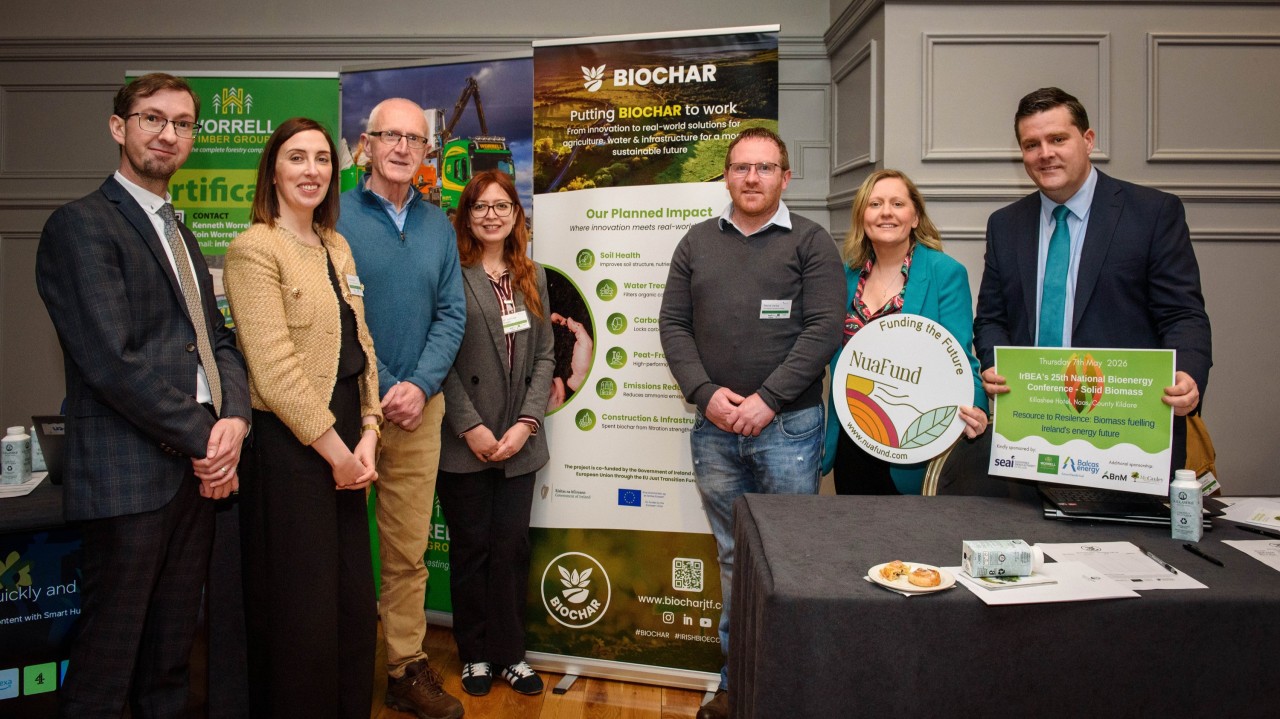
Biochar emerged as a key focus at the Irish Bioenergy Association (IrBEA) 25th National Bioenergy Conference, held at the Killashee Hotel, Naas, Co. Kildare, where industry leaders, researchers, policymakers and Government representatives gathered to discuss the growing role of carbon-based bioeconomy solutions in Ireland’s climate and energy transition.
The conference, attended by Timmy Dooley Minister of State at the Department of Agriculture, Food and the Marine and at the Department of Climate, Energy and the Environment, was held under the theme “From Resource to Resilience: Biomass Fuelling Ireland’s Energy Future.” Discussions throughout the day highlighted the increasing recognition of biochar as an important tool in carbon removal, sustainable agriculture, emissions reduction and circular bioeconomy development.
Among the speakers was Prof. JJ Leahy, BIOCHAR Project Lead from the University of Limerick, who outlined the significant opportunities for Ireland to develop biochar technologies and applications across agriculture, water treatment, construction and industry.
Speaking at the event, JJ Leahy said:
“Biochar has enormous potential to contribute to Ireland’s climate objectives while also delivering practical benefits for agriculture, soil health and carbon reduction. The research and innovation work currently underway is helping to build a strong foundation for future deployment and commercial development in Ireland.”
Seán Finan, CEO of the Irish Bioenergy Association (IrBEA), said the conference highlighted the increasing importance of biochar within Ireland’s climate and renewable energy strategy.
“There is growing recognition of the important role biochar can play in carbon sequestration, sustainable agriculture and the wider circular bioeconomy. Ireland has significant potential in this area, but continued policy support, research and industry collaboration will be critical to unlocking opportunities for deployment and innovation,” he said.
The conference highlighted the growing range of applications for biochar across agriculture, water treatment, construction, biomaterials and renewable fuel development. Industry representatives noted that increased awareness and education around biochar technologies will be essential in accelerating deployment and commercial adoption across multiple sectors.
The conference concluded with a strong call for continued investment, policy support and collaboration to help accelerate Ireland’s biochar sector and unlock its potential as part of the country’s transition to a low-carbon, circular economy.